The girl on the bridge was not inspiring. She failed.

Development is often reduced to statistics, economic growth, or stories of individual resilience. In this thought-provoking essay, Azruddin Sadik Nadaf argues that real development lies in transforming the systems that produce inequality, not merely celebrating those who overcome it. Drawing from his work with the children of migrant sugarcane workers and his learning at the Indian School of Development Management (ISDM), he reflects on why development must move beyond charity and individual success towards structural change, social justice, and inclusion. This article invites readers to rethink what development truly means and whose voices shape it.
When a photograph becomes a celebration, we stop asking the questions that actually matter. Development is not about individual courage; it is about making individual courage unnecessary.
Last year, a photograph went viral across every WhatsApp group in Maharashtra. A young girl, cycling across the bridge of Jayakwadi Dam in Paithan, in the exact moment when all twenty-seven gates of that dam were thrown open. Water rushing. Girl pedalling. Crowd cheering on social media. People called her brave. They called her determined. They said she was an inspiration to all of us, proof that nothing can stop a girl who wants to study. I looked at that photograph and felt something different. Something closer to shame.
Not ashamed of the girl, she was remarkable. Shame on us. At a system that put her on that bridge in the first place. The engineers who opened those gates without checking who was still crossing. The planners who built a dam and a school on opposite sides of a river forgot to build a safe way between them. At all of us who pressed the heart button and called it inspiration when it was actually evidence of a failure. That photograph is what thinkers who study organisations call an iceberg moment. You see the event, the girl, the water, the bike. What you do not see is everything beneath the surface: a pattern of state neglect in rural infrastructure, a structure of disconnected bureaucracies where dam management and school administration never talk to each other, and a mental model deep in our collective thinking that girls travelling through danger to reach education is somehow normal, even admirable.
The celebration of that image is exactly the problem this editorial is about. Because the same tendency to celebrate the survivor rather than fix the system shows up again and again in how India approaches development. We fund the scholarship, not the reform. We applaud the topper from the slum, not the slum's right to a school. We mourn the suicide but not the institution that caused it.
WHAT IS DEVELOPMENT, EXACTLY?
We have been measuring the wrong things for a long time. For most of the twentieth century, the world measured a country's development by its GDP, its gross domestic product, or simply, how much money it was making. A country that grew its economy was developing. One that did was not. This idea had a problem, which the Indian economist Amartya Sen spent much of his career pointing out. GDP tells you how wealthy a country is on average. It does not tell you whether the people at the bottom of that country can see a doctor, go to school, or eat a proper meal. A country can be rich and deeply unfree at the same time.
Sen's alternative was to define development as the expansion of people's real freedoms, their capabilities. Not income. Not votes cast. Actual freedoms: to be healthy, to be educated, to participate in public life, to live without fear. He called the barriers to these freedoms unfreedoms. Poverty is an unfreedom. Discrimination is an unfreedom. Not having a safe road to school is an unfreedom. Development, on this view, is the practice of removing these barriers one by one, systematically, deliberately. It is not a statistic. It is a direction of travel.
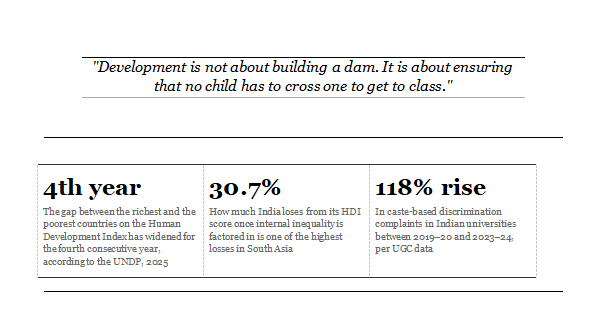
The Human Development Index, which Sen helped create for the United Nations, tries to capture this. It measures health, education, and income together. By that index, India sits at rank 130 out of 193 countries, firmly in the middle, with an HDI of 0.685. Progress is happening. Life expectancy has risen from 58 to 72 years since 1990. Schooling is up. But when you adjust that index for India's internal inequality, it falls by 30.7 per cent. That gap is the distance between the development India reports and the development ordinary Indians experience. It is a very wide gap.
WHY PROGRAMMES FAIL?
You cannot solve a web by pulling one thread. Here is a question that sounds simple but is not: why do so many well-funded, well-intentioned programmes fail to produce lasting change? The answer, usually, is that they treat a complex web as though it were a single thread. They built the school, but not the road. They train the teacher but not the school management committee. They enrol the child but do not ask why she dropped out last year. Thinkers who study organisations call this a systems problem. Any social challenge, child education, rural health, or caste discrimination is embedded inside a system: a web of people, institutions, rules, resources, and beliefs that all push and pull on each other. You cannot change one thing in a system without everything else shifting in response.
What this means for development work is that you have to understand the whole web before you start pulling. You have to ask not just what is happening, but why it keeps happening, what structures and rules and beliefs are producing the outcome you want to change.
CASE IN POINT
Between 2016 and 2021, TATA Trusts and the Maharashtra government ran a project to get the children of seasonal sugarcane workers into school. These are migrant families who move every harvest season, pulling their children out of classrooms as they go. The project ran health camps for families. It trained local panchayat members. It held community festivals to build trust. It gave adolescent girls their own communication classes. It built a mobile app to track which children were dropping out in real time. In five years, they identified 8,600 children in one district alone and got 70 per cent of them into school and kept up. The numbers worked because the thinking was whole.
THE HARDEST TRUTH
Individual effort cannot outrun structural exclusion Now comes the part of this editorial that is uncomfortable to write, and perhaps uncomfortable to read. Because of what we have discussed so far, systems thinking, good programme design, and evidence-based monitoring are all important. But it is not enough.
In January 2016, a young man named Rohith Vemula died by suicide at the University of Hyderabad. He was a Dalit PhD student, brilliant, passionate, with dreams of becoming a science writer. He had done everything right. He had, in Amartya Sen's language, expanded his capabilities: fought his way into one of India's premier research institutions against enormous odds. And then the institution destroyed him. His fellowship was suspended. He was evicted from his hostel. He was suspended, not for any academic failure but because of a complaint filed by a student organisation with ties to a political party, against the backdrop of his caste identity. He took his own life. His final letter spoke of feeling that his birth was his fatal accident.
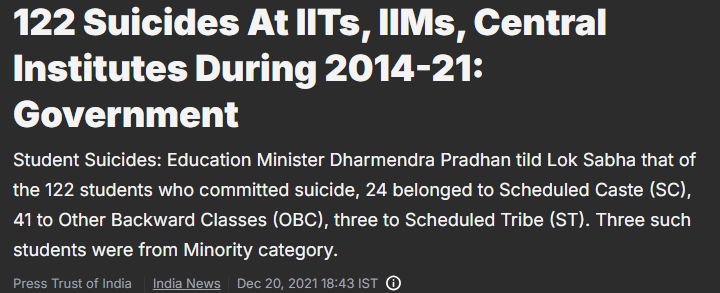
Between 2014 and 2022, 122 students died by suicide at IITs, IIMs, and central universities in India. More than half were from Dalit and Adivasi communities. An RTI filed in 2024 revealed that 82.8 per cent of IIM faculty are from dominant castes. Dalit faculty account for five per cent.
"Rohith Vemula had all the individual capability in the world. The system used it as proof that he had no excuse and then broke him anyway."
This is what researchers call institutional discrimination. Not one person is being cruel. Not one bad policy. A structure of hiring, of authority, of social norms that produces exclusion as its ordinary output, the way a broken drainage system produces flooding. No individual flood is anyone's fault. The system just works that way.
Complaints of caste-based discrimination in Indian universities rose by 118 per cent between 2019 and 2024. The number of pending cases at the UGC is rising. And the national law to address this, named the Rohith Act after Vemula himself, has still not been passed at the central level, though Karnataka took a first step in 2026.
WHAT ACTUALLY CHANGES SYSTEMS
Development needs movements, not just managers. B.R. Ambedkar understood this before anyone coined the term development management. He saw that caste was not a cultural curiosity or a social inconvenience. It was a structure that denied Dalits access to knowledge, dignity, economic participation, and political voice in an organised and deliberate way. And he understood that you cannot fix a structure with individual effort alone, no matter how extraordinary that effort is.
So he worked at every level simultaneously. He drafted a Constitution that made discrimination illegal and mandated reservations in education and public employment, which is a policy change. He built an organisation, the Scheduled Castes Federation, that gave Dalit communities political weight, that is, institutional change. And in 1956, he led the mass conversion to Buddhism of hundreds of thousands of people, that is, cultural change, the rewriting of identity and belief at scale. Each of those three levers, policy, institutions, and culture, had to move together. Move only one, and the other two push back. This is not ancient history. It is a lesson in applied development theory.
The Dalit Panther movement of the 1970s in Maharashtra built on that inheritance. Founded by writers and activists like Namdeo Dhasal and Raja Dhale, it organised Dalit communities against ongoing violence and pushed the state to legislate protections. The Atrocities Act of 1989 was not a gift from Parliament. It was a concession to organised pressure. Under that protection, however imperfect, communities could begin to build. Educational movements emerged. Dalit literature emerged. Dalit entrepreneurship emerged. Safety came first, then the capability. That sequence matters.
There is a phrase in Marathi and Hindi that captures something important about this: jisaka masala, usaki ladhai, whose issue, whose battle. The people who are most harmed by a system must be the ones leading the effort to change it. An outsider can support, resource, research, and advocate. But the core work of understanding what needs to change, and why, belongs to those who live inside the problem. Development management that ignores this tends to produce programmes that help some people while leaving the structure that harmed them completely intact. The dam gets built. The bridge is still unsafe.
INCLUSION IS NOT A PROCEDURE. IT IS A WAY OF KNOWING.
Whose knowledge shapes the plan shapes whose lives the plan serves There is a final dimension to this that does not get enough attention in development circles. We often talk about including marginalised communities, tribal students from Melghat, drought-affected families from Marathwada, and women from peri-urban settlements. We invite them to consultations. We run surveys in their villages. We count them in our beneficiary numbers.
But there is a difference between including people as targets of a programme and including them as the source of its knowledge. The philosopher Patricia Hill Collins argued that knowledge is never neutral; it is always shaped by where you stand. People who have experienced poverty know things about poverty that no survey can capture. People who have lived with caste discrimination understand its mechanics from the inside in ways that no researcher who has not lived it can fully replicate. A development programme designed without that inside knowledge will keep getting the diagnosis wrong, no matter how sophisticated its monitoring systems are. It will keep finding solutions that work for the people who designed them and miss the people they were meant to serve.
What this means practically is that good development management has to be built on participatory methods, not as a box to tick but as a genuine commitment. Who is in the room when the problem is defined? Who is setting the evaluation criteria? Whose idea of success is being measured?
Mentoring students from Melghat and Marathwada toward global scholarships taught me one thing above all others: those students did not lack capability. They lacked the connections, information, guidance, and institutional confidence that students from privileged backgrounds absorb simply by being born into them. Giving them access to those resources was not charity. It was a correction to a system that had been distributing opportunity unfairly for generations.
Through the Eklavya Global Scholar Program, five hundred students are mentored. Two hundred million rupees in scholarships unlocked. Not because we fixed the students, but because we temporarily corrected the structure of access. The right question was always: why did the structure exclude them in the first place?
"We do not need more inspiring stories. We need fewer situations that require them."
WHAT DEVELOPMENT MANAGEMENT ACTUALLY IS
Not a career. A commitment. Let us come back to the girl on the bridge. She made it across. The photograph is beautiful. And if you are reading this as a 12th standard student, you might already know something about unfreedom in your own life: a school that lacks labs, a neighbourhood that lacks libraries, a career path that your community does not recognise as legitimate, a scholarship you almost missed because nobody told you it existed. If you are reading this as a researcher or a policymaker, you know something different: that the gap between what we know about poverty and discrimination and what we actually do about it is embarrassingly large. The UNDP's 2025 Human Development Report tells us that progress on human development has slowed to its weakest pace since 1990. The gap between rich and poor countries is widening for the fourth year in a row. We are moving backwards.
Development management, understood correctly, is the practice of refusing to accept that as inevitable. It is the systematic, values-driven work of identifying and dismantling the structures, institutions, and mental models that stop people from living lives they have reason to value. It uses tools: systems thinking to understand the whole problem. Programme theory to design interventions with clarity and evidence. Results-based management to stay honest about whether real change is happening. Monitoring and evaluation as a learning system, not a reporting chore.
But it also uses values. Compassion. Social justice. Dignity. The belief, simple, radical, and still contested, that every person's life matters equally. That the girl on the bridge deserved a safe road. That Rohith Vemula deserved an institution that saw him as a scholar. Those 8,600 children in sugarcane fields deserved exactly what every other child gets as a birthright. The dam was built. Now build the bridge. And this time, post a guard before you open the gates.
Sources referenced Sen, A. (1999). Development as Freedom. Knopf. | UNDP (2025). Human Development Report 2025. | Economic & Political Weekly (2021). Rohith Vemula: Caste Oppression in Indian HEIs. | TATA Trusts (2021). Digital Education Guarantee Card Project Report. | UGC data as reported in Deccan Chronicle (2026). | The News Minute (2025). Rohith Act analysis. | Collins, P.H. (1990). Black Feminist Thought. Routledge. | Tarrow, S. (2011). Power in Movement. Cambridge UP. | Meadows, D. (2008). Thinking in Systems. Chelsea Green.