Reimagining Education in India
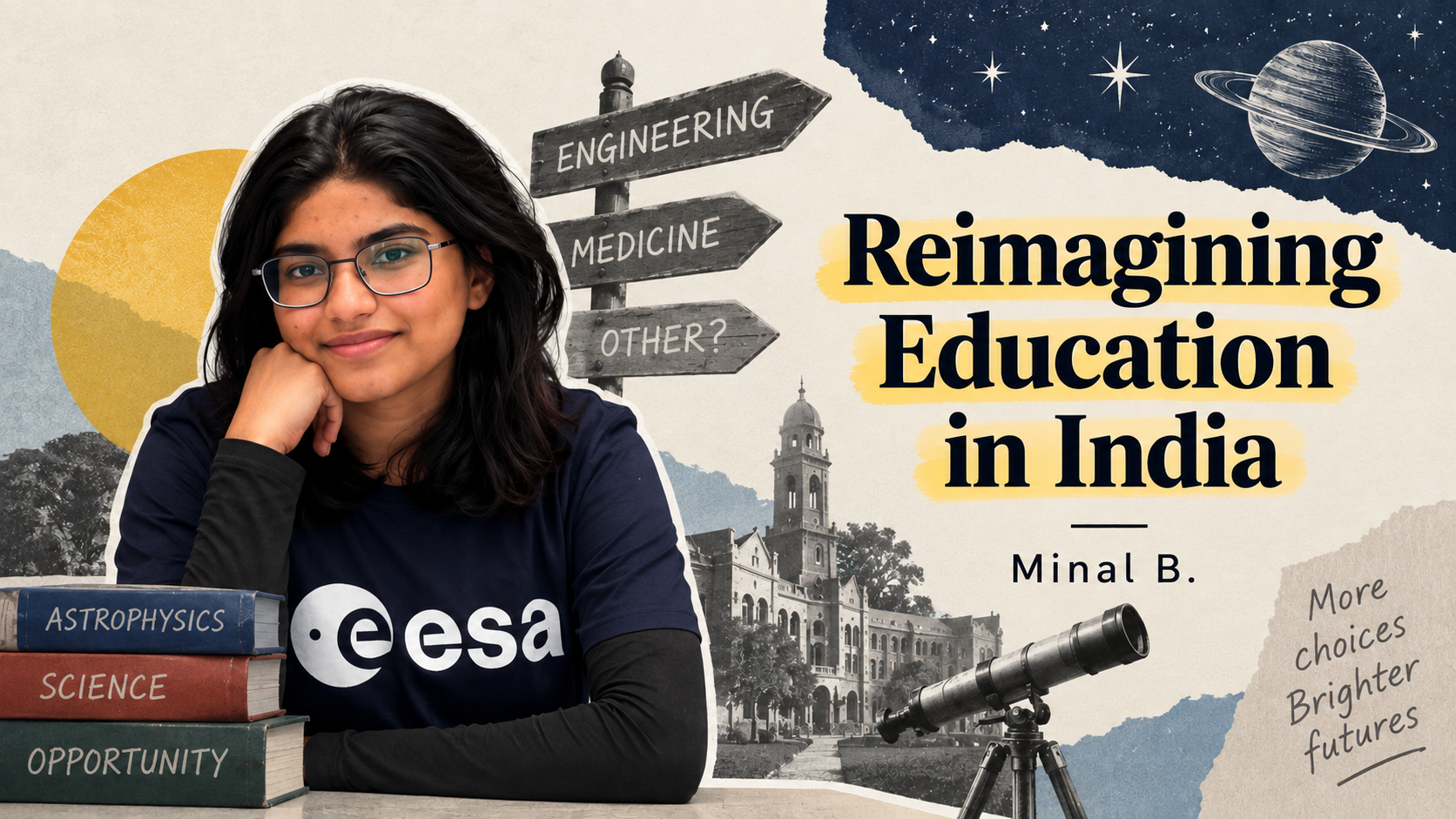
In this essay, Minal B. reflects on what it means to pursue an academic interest in a system where educational choices are often narrowed long before students are ready to make them. Drawing from her own experience of trying to find a path into astrophysics, she examines the gaps in career guidance, access, and opportunity that shape how young people imagine their futures. Minal brings together personal experience, research, and examples from other education systems to ask a larger question: what would it take to make education in India more open, diverse, and genuinely liberating?
I grew up in a home built by two people who came to Mumbai without knowing the city yet, and learned it as they went. My father, now a government officer with a background in science and veterinary, and my mother, a counselor with a background in English Literature and computer science - both grew up in rural Maharashtra and moved to Mumbai for work. They were still learning to navigate the city themselves while trying to make sure their children got an education, and a life they were genuinely passionate about. They were educated, capable, and supportive in every sense. What none of us had, when I said I wanted to study Astrophysics, was a clear sense of where the door even was, let alone how to open it. Which entrance exams mattered, which colleges taught subjects with astronomy at the forefront, and by what door one was supposed to enter them. We asked relatives, teachers, anyone who might know. We found fragments of answers, usually too late to act on. By the time I understood the actual shape of the path I wanted to walk, several of its early gates had already closed behind me. This essay is about what happened in the space between my ambition and the information I needed to pursue it. It is about a system that put most Science based education under the umbrella of Engineering and Medicine.
My experience In India, astrophysics is rarely offered as an under graduate major at public universities. Where it exists at all, it typically sits behind a small number of entrance exam gated institutions, or waits until a master’s degree, after a general BSc and another competitive exam simply to be allowed to specialise. For a 16 year old in 2016, that meant the subject itself was not really accessible, only the idea of it, several years and several exams away.
I did find something in the meantime: Astronomy lecture series organised at Wilson College in Mumbai. They were insightful, and they gave me something that I could not find in a syllabus, a real sense of where in Astrophysics I wanted to work. But a lecture series, however generous, is not structured formal learning. Astrophysics is not just baseline physics with a telescope attached: it requires a scaffolded understanding of space itself, each idea in gravitation, radiation, and stellar structure built carefully and delivered by people trained to teach exactly that sequence.
What eventually opened the door for me was leaving the entrance-exam system altogether. A university in the UK offered me direct undergraduate admission into a physics and astrophysics programme on the strength of my twelfth-grade marks alone, solid but not exceptional, with no Entrance exam required. Once there, I had full access to structured, sequential teaching in exactly those areas I had been trying to piece together. I am conscious of what let me take that route: a family that could support an international application, enough exposure to know the option existed, and enough English-medium schooling and cultural familiarity with the process to make it feel possible rather than remote. Most students with the same curiosity I had do not have access to any of that. For them, it is something they cannot afford to prepare for, or it simply is not offered in their areas and thus that subject stays closed to them, no matter how ready they are for it. Education, at any level, should not have to be earned through a single high-stakes exam before a student is even allowed to begin studying the thing they love.
A private failure with a public shape It is tempting to read stories of people not being able to pursue their dream career as that person’s misfortune. The research suggests otherwise. Choudhary and Kumar’s 2026, household-survey analysis of professional higher education in India finds that access to fields like engineering, medicine, and management remains sharply stratified by caste and household economic status, and that a meaningful share of this gap persists even after accounting for income. Thorat and Sabharwal’s (2015) work on caste and social exclusion frames this as a structural feature at her than an accident: disadvantage compounds not only through money, but through the absence of the informal networks, mentors, and ‘insider knowledge’ that better-off, better-connected families take for granted.
My own family had more resources than most, and we still navigated blind. A student from a lower-income household, a first-generation learner, or a family without an urban professional network faces the same fog, only thicker, with fewer people around them who have already found their way through it. Reservation policy in India was designed to correct for exactly this kind of structural disadvantage in admissions (Choudhury and Kumar, 2026). But as eatreserved at the end of the road does little for a student who was never told the road existed, or whose subject was never offered on it at all. Equity that begins at the point of admission, and not at the point of awareness, arrives too late for many who need it the most.
The economy that grew inside the gap Where formal guidance is scarce, a private industry has filled the vacuum. Kumar and Roy Chowdhury’s analysis of national survey data estimates India’s shadow education sector, private tuition and coaching, at somewhere between forty and seventy billion US dollars, with participation shaped heavily by household income, urban residence, and parental education (Kumar & Roy Chowdhury, 2021). Their findings echo something I recognise from my own adolescence: coaching institutes have become, for many families, not a supplement to schooling but a replacement for the guidance schooling failed to provide. When a school cannot reliably tell a curious student where astrophysics leads, a coaching centerin a near by town will, for a fee that some families simply cannot spare.
A ladder with only Rungs When we ask most Indian teenagers to name a respectable career, and the list narrows fast: engineer, doctor, and then, hesitantly, something else. That narrowing is not accidental. It is reinforced daily, at family gatherings, in school assemblies that celebrate that year's JEE and NEET toppers, in the quiet calculus of what a marriage proposal or a promotion committee will find impressive. For enormous numbers of Indian families, education functions less as a means of understanding the world and more as a status symbol, a credential that reflects well on the family rather than one that serves the person carrying it.
My own parents never confined me to that list; they would have stood behind me on any path I chose. But support at home does not change what the system itself is built to offer. The moment I looked beyond our living room, at school, in career-guidance material, in the casual assumptions of relatives and teachers, the range of offers still narrowed to the same two rungs, as though nothing else was seriously worth naming. A household that says yes to anything cannot, on its own, undo a system that was only ever built to say yes to two things.
The costs of that narrowing are not abstract. Kota, Rajasthan's coaching hub, draws over two lakh students a year chasing essentially two exams, and its suicide numbers have climbed accordingly, with one recent year setting a grim record (Pal, Bhesera, & Bika, 2026). Coaching staff there have described parents who refuse to accept honest feedback about a struggling child, insisting there is no acceptable direction except forward, because a loan has already been taken and a family's expectations already set in motion (Press Trust of India,2023). None of this is any single parent's fault. It is what a society produces when it spends a generation teaching children that their worth is a rank on a list.
Education as liberation There is an older, different way to think about what education is for. Paulo Freire argued that education, at its best, should function as a practice of liberation, expanding a person's capacity to read, question, and reshape the world around them, rather than depositing information into a passive recipient in service of someone else's definition of success (Freire, 1970/2000). That framing, more than fifty years old, feels urgently current for India. A system that measures itself only by rank lists and exam cutoffs is not liberating anyone. It is sorting them. A system worth building would instead ask what a student becomes freer to understand, question, and build, in their own life and in the world around them, regardless of whether that leads to an engineering seat.
This reframing also means letting go of the idea that education belongs only to the young, or that it must follow a single, line art rack. UNESCO's articulation of lifelong learning treats the right to education as one with no age limit, spanning formal, non-formal, and informal learning across a person's whole life (UNESCO Institute for Lifelong Learning, 2023). My own mother's path, English literature and computer science before eventually training as a counselor, is a small, ordinary reminder that a working life rarely moves in a straight line, and that a good education system should make room for people to return, retrain, and redirect at any age, rather than treating one's twenties as the only window that counts. In India, that principle would mean adult literacy and skilling programmes, evening and community classes, and second-chance pathways into higher education, treated as core public infrastructure rather than an afterthought.
Reform also has to reach the substance of what a classroom teaches, not only who can access it. A large body of research on social and emotional learnings how's that programmes building self-awareness, empathy, relationship skills, and responsible decision-making produce measurable gains in both wellbeing and academic outcomes (CASEL, 2023). Ethics and moral reasoning can be taught as a standalone, secular strand of that curriculum, distinct from religious instruction, organized around shared questions of fairness, honesty, and responsibility to others rather than any one tradition's specific answers to them.
UNESCO's education-for-sustainable-development framework offers a template for weaving environmental responsibility and community engagement through the curriculum as a lived practice, not a single chapter on the water cycle (UNESCO, 2023). None of this competes with academic rigor. Together, it is what turns a school from an exam pipeline into a place that also builds the kind of person who can hold community, ethics, and a livable planet in mind a long side a career.
Looking elsewhere Comparative education research offers not emplate that transfers wholesale, but it does offer principles worth sitting with. Finland's system is often invoked, sometimes lazily, but the substance behind the reputation is specific: teachers hold mandatory master's-level training, exercise real classroom autonomy, and are trusted as the primary assessors of their own students, while standardized national testing is minimal until the very end of upper secondary school (Sahlberg, 2011). The result, according to researchers who have studied Finnish equity out comes, is a system where a student's socioeconomic background predicts their achievement far less strongly than it does in more testing-heavy systems.
Germany's dual vocational education model offers a different lesson. Roughly half of German secondary students move through an apprenticeship system that combines paid, structured work place training with part-time vocational schooling, producing nationally recognized qualifications that carry real labor-market weight(OECD,2023). Vocational and academic paths are not ranked; they are simply different doors into a respected working life. That parity, more than any specific curriculum, is a piece India's engineering-or-nothing culture is missing.
Singapore's Ministry of Education has taken perhaps the most direct approach to the problem I lived through. Its Education and Career Guidance framework places trained counselors inside every secondary school and post-secondary institution, supported by a national digital portal where students can research pathways, deadlines, and options as early as Grade 9 (Ministry of Education, Singapore, 2026). It is, in effect, an institutional answer to the exact question my family spent a year failing to answer on our own.
A model None of these system scan be imported intact into a country of India's scale and diversity. But their underlying logic can be. I would propose seven connected pillars, each addressing a different point of failure in the current system.
- First, place trained career and academic counselors in every government school, not only elite private institutions, so that guidance stops being something only well-connected families can privately arrange.
- Second, invest directly in teacher training, pay, and classroom autonomy, so that schools themselves can deliver the strong foundational instruction that coaching centerso currently profit from replacing.
- Third, build a single, free, publicly maintained database of exams, timelines, eligibility criteria, and scholarships, so that no family has to reconstruct that information from scattered relatives and word of mouth, the way mine did.
- Fourth, open direct-entry undergraduate path ways into specialized and emerging fields at public universities, so that a subject like astrophysics is not effectively rationed to whoever can clear a single high-stakes exam, or postponed for years until a postgraduate degree.
- Fifth, formally elevate vocational and alternative academic tracks to parity with engineering and medicine, easing the singular pressure that currently funnels so much ambition toward a narrow set of exams, and increasingly, toward the idea that a real education can only be found abroad.
- Sixth, invest in a public, generational shift in how success is defined and talked about, in school assemblies, in media, in family conversation, so that a young person's worth is no longer measured against a rank list, and their wellbeing is treated as seriously as their results.
- Seventh, embed social-emotional learning, secular ethics, sustainability, and community engagement into curricula at every level, while extending access to adult and second-chance learners, so that education functions as a lifelong practice of liberation rather than a single decade-long credentialing race.
Closing the distance I do not regret where my own path eventually led. But I think often about a version of myself who never had to leave to find it, who could have walked into a public university at eighteen and simply studied astrophysics, no exam gauntlet, no international application, no waiting for a master's degree to be allowed to specialize. Every year, a great many capable, curious students make the same calculation my family made, quietly, without much fanfare, and each one is a small verdict on what India's education system has not yet built.
India does not lack talent, curiosity, or ambition; the evidence of that is everywhere. What it still lacks is the connective tissue, the counselors, the information, the open doors into specific subjects, and a wider, freer idea of what education is even for, that turns ambition into outcome regardless of where a student starts. Building that issue would give more students real reasons to stay, and let those still learning at forty or sixty see that choice as timely, complete, and entirely their own.