Intersectional Feminist Foreign Policy
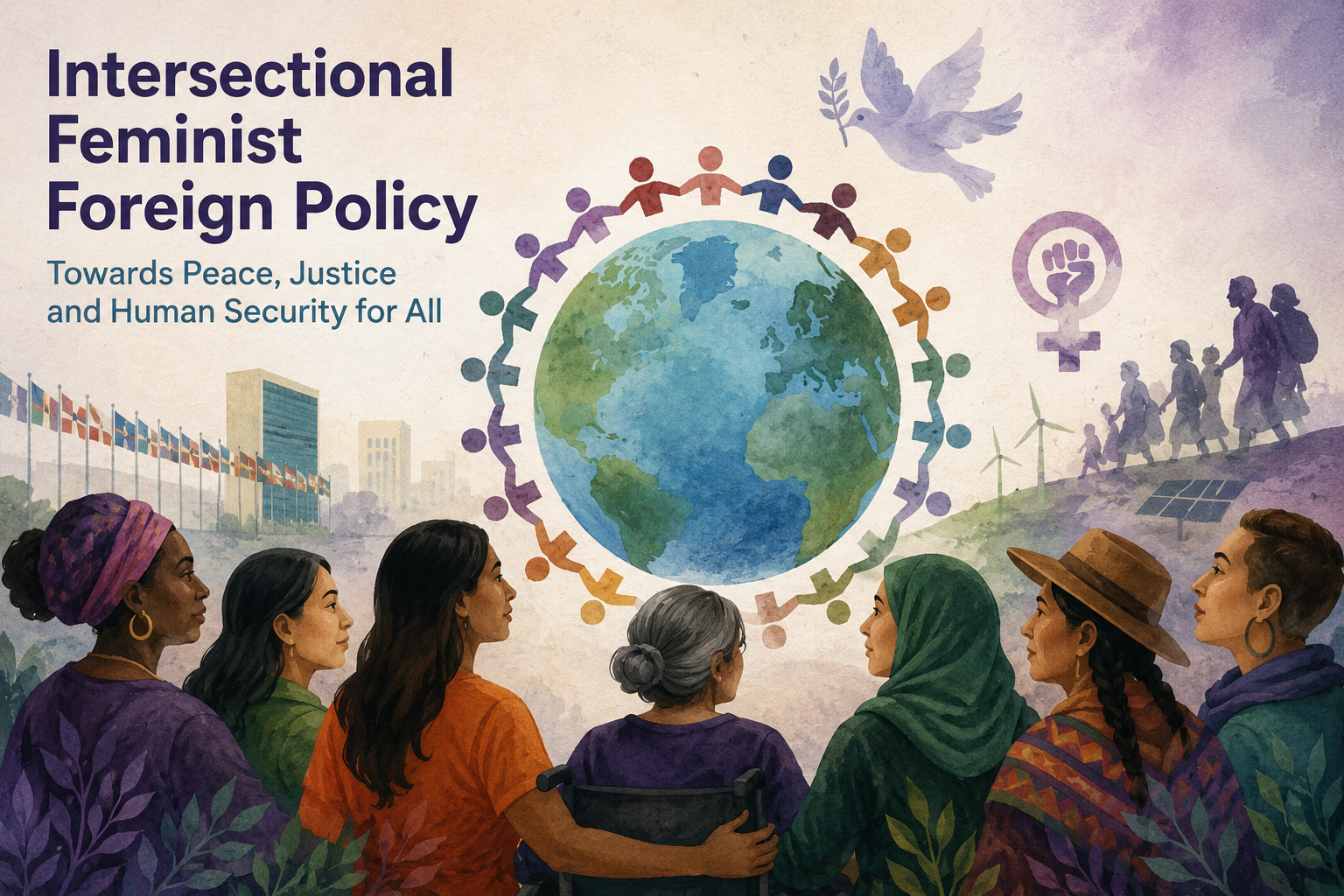
In this article, Prof. Vibhuti Patel, former Professor at the Advanced Centre for Women’s Studies, Tata Institute of Social Sciences (TISS), and former Head of the Economics Department at SNDT Women’s University, explores the concept of Intersectional Feminist Foreign Policy (IFFP) and its growing relevance in contemporary global affairs. She argues that foreign policy must move beyond traditional notions of national security to focus on human security, gender justice, peace, and inclusive development. Drawing on global feminist movements, the Women, Peace and Security agenda, and contemporary geopolitical challenges, the article highlights the importance of incorporating the voices and experiences of women and other marginalized communities into diplomacy and international relations. Prof. Patel makes a compelling case for a more equitable, inclusive, and justice-oriented approach to global governance.
Intersectional feminist perspective has emerged from transnational feminist solidarity over the past fifty years that is responsive to post-colonial sociocultural reality, hierarchical international relations, local political dynamics, lived experiences of citizens in a specific country and diverse voices across gender spectrum. Feminist activism to combat global issues- such as devastating impact of structural adjustment programmes and stabilisation policies imposed on the nation-states, global human trafficking, draconian and vertically imposed population control policies, gender based violence, plight of refugees and cruelty towards cross-country migrant people, rights of political prisoners, fight against militarised masculinities thriving on military industrial complexes of the rich nations- also contributed to paradigm shift in diplomatic discourses that earlier focused only on ‘National Security’ i.e. sovereignty and territorial integrity of the nation state to recent concern for ‘Human Security’ i.e. economic and political security, health and well being, safe environment, physical safety, harmonious community life.
The Intersectional Feminist Foreign Policy (IFFP) not only focuses international relations between the nation states but also on political cultures and thoughts that reflect economic, political, diplomatic priorities and human rights of the socioeconomically under-served sections.
Vision, Mission, Goals, Objectives of IFFP: An Intersectional Feminist Praxis is based on the foundation of famous feminist formulation that ‘Personal is political’ of 1970s, which conveys that women’s personal predicaments are outcome of political conditions maintained by patriarchal structures and systems instituted and guarded by the state. Hence programmatic interventions demanded by the FFP in the global diplomacy include both domestic and international agenda. This includes combating sexual and sexist violence; education of women, girls, men, boys and transgender persons; economic emancipation of women across the world; representation and voices of women in politics and decision-making bodies at local-subnational-national-regional and global bodies; and proactive efforts of involving women in peace negotiations and treaties. Intersectional approach in FFP demands conscious measures in terms of inclusion of ethic, linguistic, religious, gender minorities, persons with disabilities, elderly people across gender spectrum as well as oppressed castes and historically persecuted nationalities in the diplomatic missions. An overarching concern of FFP is Gender equality. FFP ensures that women-girls and gender minorities enjoy fundamental human rights that the global community must strive for as a responsibility within our planetary commitments and obligatory to achieving comprehensive foreign policy goals of peace making/peace building/peacekeeping, national-&-human security and sustainable development.
Contemporary Challenges and Feminist Solidarities: Global feminist movements have expressed feminist solidarity through issuing statements, providing shelter and security to the survivors of wars and conflicts and varied for of GBV. Zan, Zindagi, Azadi (i.e. women, life, freedom) this stirring slogan after death of Ms. Mahsa Amini in 2022, raised by the Iranian women, captures the essence of women’s protests across the world. In Afghanistan women and girls are asking for right to education, freedom to move, opportunity to take part in sports and public life, employment opportunity and fighting against forced child marriages and forced child motherhood. In China, women are asking for representation and voice in the political sphere. In India, Muslim girls are fighting against being thrown out of schools and colleges for wearing hijab. In Mexico women have been fighting against femicide. In Chile, women’s march against GBV received global sport from women and girls. Thousands of women in USA, women are fighting against withdrawal of women’s right to abortion. Global solidarity for Ukrainian women is against sexual violence perpetrated by the Russian soldiers is supported by feminists within Russia. In all discourses on Sustainable Development Goals, global feminist discourses are keeping WPS agenda centre-stage and focusing on multiple catastrophes and insurmountable problems faced by women due to resurgence of conventional war with current Russian invasion of Ukraine and horrifying carnage in Gaza. Only feminists are highlighting an urgency of robust discussion on contingencies of war with gender lens.
As the core concept of FFP has been ‘Women, Peace, Security’, the landmark UN Security Council Resolution 1325 adopted in 2000 needs to become an urgent action plan for Inter Parliamentary Union. Feminists are demanding multi-stakeholder policy that includes peace delegations, defining approach, qualitative change from quantitative, challenging binaries in diplomacy where women are classified as nurturer, emotional,victim.
Underrepresentation of Women in Diplomacy: The global voices of the feminists movements are geared to the demand for equity and demand that ‘work with women, not work for women’ and ‘power for women, not power over women’. At present women are marginalised in diplomacy. Women as participants are there in the diplomatic assignments, but women are not decision makers. Women have to navigate challenging stereotypes in domestic as well as global space. Here too, intersectional perspective is required to be responsive to geographical and cultural differences. (Etten, 2014). Core concept of Intersectional FFP is focussed on the bottoms up approach. In the domestic arena, FFP stresses political participation of women not only as voters, but women must stand for election and formal recognition of women in decision making through national legislation. Another important concern of FFP is that several countries have not ratified Optional Protocol to Convention on Elimination of all forms of Discrimination against Women (CEDAW)’ that recognizes the competence of the CEDAW Committee, the body that monitors compliance of the nation states parties with the Convention to receive and consider complaints from individuals or groups within its jurisdiction. FFP is multidimensional and strives to make a government include domestic and global gender equality issues one of its central goals in the international relations and diplomacy with an aim to improve the experiences and the quality of life of women and marginalized groups.
Transnational feminists Efforts & UNSC: Over last 50 years, global feminist efforts have been directed at a greater representation of women in foreign policy decision making, development assistance for empowerment of women and placing gender and women’s vulnerability on the transnational security agenda. Let us not forget that, currently, there are 48 places on this planet where territorial wars or civil wars are fought resulting in massive human miseries marked by homelessness, sexual violence, diseases, hunger, human trafficking.
United Nations (UN) Security Council Resolution 1325: Thirteen Twenty Five (in the year 2000) on Women Peace and Security (WPS) was the first UN resolution to recognise the central role of women as change agents in contributing to international peace and security. This was the first resolution to recognise the differential and disproportionate impact of conflict on women and girls and affirm the importance of women’s participation as active agents in peace and security processes. The resolution introduced four “pillars” or priority areas of the WPS agenda:
- Participation calls for women to participate equally with men in peace, political and security decision-making processes at national, local, regional and international levels.
- Protection seeks to ensure that women and girls’ rights are protected and promoted in conflict-affected situations and includes protection from SGBV.
- Prevention refers to the prevention of all forms of violence against women and girls in conflict affected situations and includes fighting impunity and involving women in conflict prevention.
- Peace building and inclusion of women’s specific needs during repatriation, resettlement and for rehabilitation, reintegration and post-conflict reconstruction
Since the adoption of this hall mark resolution 1325 by the United Nations Security Council (UNSC), nine subsequent resolutions have emphasized the importance of putting women at the heart of peacekeeping. The implementation of the WPS agenda is also one of the eight priority commitment areas in the Secretary-General’s Action for Peacekeeping (A4P) initiative. The Security Council has adopted ten resolutions that comprise the Women, Peace and Security (WPS)-1325 (2000), 1820 (2008), 1888 (2009), 1889 (2009), 1960 (2010), 2106, (2013), 2122 (2013), 2242 (2015), 2467 (2019), and 2493 (2019). The term WPS is used to highlight the linkage between women’s roles and experiences in conflict, peace and security. Obligations in these resolutions extend from the international to the local level, and include intergovernmental organisations, such as the United Nations to national governments. The WPS mandates are the blueprint for all work conducted on gender in peace operations.
An official acknowledgement of Conflict-related sexual violence refers to rape, sexual slavery, forced prostitution, forced pregnancy, forced abortion, enforced sterilisation, forced marriage, trafficking in persons when committed in situations of conflict for the purpose of sexual violence/exploitation and any other form of sexual violence of comparable gravity perpetrated against women, men, girls or boys that is directly or indirectly linked to a conflict.
There has been criticism that UN Security Council 1325 on Women, Peace and Security (WPS) has conceptualised this violence through a focus on widespread and systemic rape strategically used in war which has continued to render invisible domestic violence and sexual harassment of women, girls and even boys.
Geopolitics and Marginalisation: Contemporary world is governed by the rulers guided by overarching neoliberal ideology and action strategies of hypernationalism, extraction of resources that are crucial for existence and livelihoods of the local communities, manipulation of historical facts, autocratic control over media- educational institutions- criminal justice system by the plutocrats, weaponisation of sectarian values, hypermasculinity and misogyny, demand of unconditional loyalty, erosion of professionalism and populist feminism.
Low-and middle-income countries (LMICs) in the Middle East and North Africa (MENA) have faced a series of interrelated crises in recent years relating to political instability, economic crisis, food and energy scarcity, collapse of public health system and high debt. The coronavirus pandemic aggravated their multifaceted crisis. Moreover, the war in Ukraine has brought to light disparities in the region, underlining that the situation among Arab countries differs. While rising energy prices because of the conflict have resulted in a hydrocarbons windfall for oil-exporting countries, energy importers such as Egypt, Tunisia, and Lebanon have faced higher energy bills, budget constraints, and social pressures. The debt crises that countries such as Egypt, Tunisia, and Lebanon are facing are rooted in the political economy and model of economic development that each of these three countries has pursued. The situation of women in the DRC, impact of the war on women's safety, their access to healthcare and their living conditions in a context of extreme violence. Today, the Congolese women are on the front line of the atrocities caused by the war in eastern DR Congo. It is more important than ever to be fully aware of their reality and to understand the extent of the violence they suffer on a daily basis. It is important to recognise relationship between misogyny, militarisation and the presence of armed groups and heightened brutal violence against women, the difficulties of access to healthcare for displaced women, pregnant women and victims of sexual violence in conflict zones and the consequences of rape used as a weapon of war and the obstacles faced by the rape survivors in obtaining justice.
Disasters, Marginalisation and Global Solidarity Effort: Intersectional feminism brings the voices of women and gender spectrum experiencing overlapping, concurrent forms of oppression in their praxis and an action agenda. The intersectional lens recognizing the historical contexts and political economy of 200 years of colonisation of Latin America and Asia and 500 years of slavery that was marked by histories of economic exploitation coupled with brutal violence and systematic discrimination resulting in inequities between the rich nations of the North and the poor nations of the South. These inequalities of poverty and deprivation, casteism/ racism/sexism, result in generational violation of democratic rights and equal opportunities. By charting these epistemic erasures, the feminist foreign policy can direct our efforts for transformative change and consistently engage in difficult conversations on foreign policies, diplomatic moves and international relations.
Feminist Efforts at Peace-building: Grassroots women's involvement in peace-making, peace building and peace keeping brings a broader understanding of security, focusing on community needs, social justice, and equity. A peace-building approach that prioritizes inclusivity of all stakeholders and recognizes diverse voices-especially those of women and intersectionally marginalized groups create sustainable peace by addressing the needs and experiences of all individuals affected by conflict. Traditional approaches of peace negotiations and ground level interventions have been often male-oriented, focused on military or diplomatic solutions, while the feminist approaches emphasize equity, social justice, and holistic conflict resolution by valuing contributions from all genders. For example, In 2007, the Indian women peacekeepers deployed in the war-torn Liberia with the UN Mission in Liberia (UNMIL) have been recognized for their constructive impact and empowering influence for Liberian women and girls. These all-women Indian Formed Police Unit (FPU) have played a crucial role in post-conflict stability, security, and capacity building and also served as role models for women entering the security sector in Liberia. Over last 3 decades, feminists have played pivotal role in the war tron countries such as Angola, Iran, Ukraine, so on and so forth in terms of tackling the challenges of landmines and other explosive materials implanted by the war mongers and cleared contaminated land, raised awareness among war affected communities, and provided support to the survivors of wars/civil wars/ethnic cleansing. Feminists have been involved in de-land mining operations, advocating for the human rights of survivors, and ensuring gender responsive and need based relief and rehabilitation to intersectionally vulnerable populations.
Gender, International Relations and Diplomacy: The theoretical foundations of International Relations are still primarily based on traditional male–female dichotomies, particularly that of separation of public and private spheres. By extension, women are largely excluded from state power and decision making. The state is itself gendered and democracy governance, dialogue on foreign trade policy and diplomacy remain largely male-streamed. There is an urgent need to promote feminist interpretations of three main international relations areas, namely international security, human rights, and international political economy and their implications for gender policies. In the foreign policy and diplomatic negotiations it is important to bring centre-stage- how gender is interacting with issues related to international relations, diplomacy, peace and security, development, and human rights. For gender issues to gain visibility in contemporary politics and action agenda, representation and voice of gender spectrum is inevitable.
Conclusion: In the domestic as well as foreign policies, to counter gender stereotypes created by the patriarchal systems and structures must be given top priority by the state and non-state actors. Developing leadership of women and sexual minorities in the development programs demands mainstreaming of gender sensitization programmes. In the action agenda, Intersectional feminist foreign policy needs to include a gender responsiveness to the impact of business activities on natural resources, water and energy use, supporting new business models that can deliver clean/renewable energy, establishing sustainable procurement policies and supplier codes of conduct, promoting responsible consumption through marketing and public relations events, sponsoring NGO/CBO/CSO initiatives to rejuvenate and restore degraded habitat and transformative policies for gender equality, promote gender responsive budgeting and transformative financial policies. The idea of a ‘gender-sensitive foreign policy’ as a multidimensional policy framework that aims at gender justice, reproductive justice, environmental justice, social justice, economic justice and distributive justice is getting traction due to 17 Sustainable Development Goals. The SDGs clarion call, “Gender Equality Today for sustainable Future Tomorrow” demands transnational solidarity resting on the foundation of IFFP framework and praxis.