Feminist Praxis to Combat Prebirth Elimination of Girls
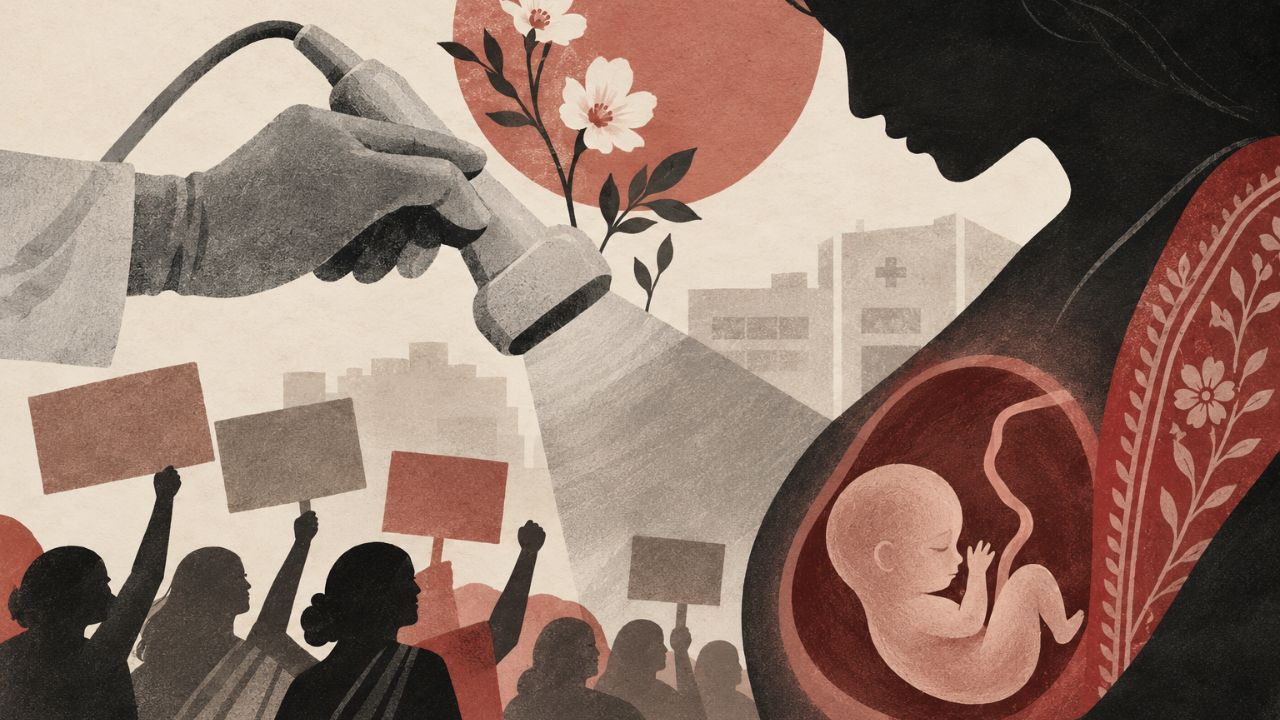
Dr. Vibhuti Patel, a feminist scholar and founding member of the Forum Against Sex Determination and Sex Pre-selection, has been part of the struggle against sex-selective practices in India. In this article, she examines how medical technologies such as amniocentesis and ultrasound came to be used to identify and eliminate female foetuses. She points out that this is not simply about individual choice, but is deeply connected to son preference, social pressure and the unequal status of women. The article also asks an important question: can we call it a free choice when women are making decisions within such unequal social conditions?
Forum Against Sex Determination and Sex Pre-selection began its campaign against discriminatory abortions of female foetuses in India in April, 1986 and its first action was picketing by over a dozen feminist activists in Mumbai in front of a reputed hospital that boasted of performing 8000 Amniocentesis (sex selection) tests on pregnant women, claimed that only one pregnant woman with three sons wanted a daughter and 7999 pregnant women wanted only sons and as the hospital was against abortion, it advised those women whose tests had shown female foetuses to go for abortion elsewhere but were told to bring back aborted foetuses back to the hospital for further research.
Their placards displayed had slogans in English, Hindi, Marathi, Gujarati: “Eliminate Inequality, not Women”, “Destroy Dowry & Dehumanisation, not Daughters”, “Say ‘No’ to Sex-determination, say ‘Yes’ to Empowerment of Women, say ‘No’ to Sex Discrimination, say ‘Yes’ to Gender Justice”, “Daughters are not for slaughter”, “Stop Femicide, Promote Equity”, “Girls are the equals of boys, all they need is opportunity”, “Sex Selection is a Crime against Humanity”, “Respect bodily integrity of women”, “Women are not son-producing machines” and so on. After 4 hours of shouting slogans holding placards in hands, distributing leaflets and collecting signatures against selective abortion of female fetuses, Dean of the hospital called the delegation of picketers (that included me) for discussion. He asked each of us, “How many children do we have?” When one picketer said, “Two sons”. He shouted at us and said, “So you are happy with your sons! Why don’t you allow others also to be happy by use of sex selection tests? When he asked me the same question, I replied, “One daughter”. The Dean sniggered, “Now I understand why you are picketing. Because you are jealous of those who have sons or are making efforts to have son.” We had basic problem of wavelength and this continues till today. Medical fraternity by and large does not see it as violence against women.
Advances in medical science have resulted in sex-determination and sex pre-selection techniques such as sonography, fetoscopy, needling, chorion villi biopsy (CVB), amniocentesis, ultrasound and currently self-help kit. These ranges of tests have become household names not only in the urban India but also in the rural India. Indian metropolis are the major centers for sex determination (SD) and sex pre-selection (SP) tests with sophisticated laboratories; the techniques of amniocentesis and ultrasound were used even in the clinics of small towns and cities of Gujarat, Maharashtra, Karnataka, Uttar Pradesh, Bihar, Madhya Pradesh, Punjab, West Bengal, Tamil Nadu and Rajasthan in the late seventies. A justification for this was aptly put by a team of doctors of Harkisandas Narottamdas Hospital (a pioneer in this trade) in these words, “…in developing countries like India, as the parents are encouraged to limit their family to two offspring, they will have a right to quality in these two as far as can be assured, Amniocentesis provides help in this direction”. Here the word ‘quality’ raises several issues that we discussed with those doctors when they shared their paper with us in 1882.
Dynamics of Missing Women in the contemporary India:
Legacy of continuing declining sex ratio in India in the history of Census of India has taken new turn with widespread use of new reproductive technologies (NRTs) in India. NRTs are based on principle of selection of the desirable and rejection of the unwanted. In India, the desirable is the baby boy and the unwanted is the baby girl. The result is obvious. As per the Census of India, child (0-6 age group) sex ratios were 971, 945, 927 and 914 for 1981, 1991, 2001 and 2011, respectively. Now, it is officially accepted that, this deplorable scenario is a result of the widespread use of SD and SP tests throughout the country. The Census results of 2011 have revealed that Child sex ratio (0-6 years) in India is 914. Increasing trend in the child sex ratio (0-6) seen in Punjab, Haryana, Himachal Pradesh, Gujarat, Tamil Nadu, Mizoram and A&N Islands. In all remaining 27 States/UTs, the child sex ratio show decline over Census 2001. Mizoram has the highest child sex ratio (0-6 years) of 971 followed by Meghalaya with 970. Haryana is at the bottom with ratio of 830 followed by Punjab with 846. Literacy rate has gone up from 64.83 per cent in 2001 to 74.04 per cent in 2011 showing an increase of 9.21 percentage points. The increase in the gender ratio, from 933 to 940 women per 1,000 men, got drowned in the alarming decline in the number of girls under 6 years: from 927 to 914 per 1,000 boys. In some states, that ratio went below 800 girls per 1,000 boys. The census figures showed that while the child sex ratio in rural areas is 918 girls per 1,000 boys, the figure is 904 girls per 1,000 boys in cities and urban areas. Now, we are waiting for the census result of 2026 for child sex ratio.
Science in Service of Femicide:
In 1972, when Amul Dairy Introduced Chorion Villai Biopsy (CVB) to determine sex of foetus among cows and buffalos, it was for sex selective abortion of male foetus as more bullocks were not needed for agrarian chores. Agricultural mechanization and tractorisation had replaced them. My caste, Patidars of Kheda and Mehsana district quickly started using CVB for identification of sex of foetus on pregnant women in their families and aborted female fetuses. Women members of my clan from Anand and Vidyanagar would share the stories about selective abortion of female foetuses in their families with me. In 1974, when veteran leaders such as Mrinal Gore, Ahalyatai Rangnekar, Manju Gandhi and Tara Reddy came to Vadodara (my native place) to form Anti Price Rise women’s Committee; I share this mind-boggling issue in my community. They laughed at me and told me, “You must be reading too many science fictions. People do not have money to pay for safe drinking water. Do you think they will pay for examination of amniotic fluid?”
1975 AIIMS in Delhi, the All India Institute of Medical Science began conducting a sample survey of amniocentesis in 1974 to find out about foetal genetic conditions and easily managed to enroll 11000 pregnant women as volunteers for its research. The research team found that the main interest of these volunteers was to know sex of the foetus. Once the results were out; those women who were told that they were carrying female fetuses, demanded abortion. Newly formed Centre for Women’s Development Studies led by Dr. Veena Mazumdar met the Health Minister and gave petition demanding immediate ban on the use of SD tests for abortion of female fetuses. But during Emergency Rule, the state was interested in only population control and saw the SD tests as effective tools to attain population stabilization.
In 1977, a feminist working at J.J. Hospital, Mumbai as a microbiologist reported the test being conducted in the government hospital in a meeting of Feminist Network, Mumbai. In the post Emergency period, when women’s studies scholars connected sex selective abortions with continuous trend of declining sex ratio as revealed by the Census Reports, it motivated the Union health minister, Mr. Raj Narayan to ban the SD tests for sex selection in all government run hospitals in 1978. Since then, Private sector started expanding its tentacles in this field so rapidly that by early eighties Amniocentesis and other sex selection tests became “bread and butter” (as told to me by a gynaecologist in Amreli, Gujarat) for many gynaecologists.
During 1980s, other tests, CVB for SD and preplanning of the unborn baby were used SP tests. Diet control method, centrifugation of sperm, drugs (tablets known as SELECT), vaginal jelly, ‘Sacred’ beads called RUDRAKSH and recently advertised Gender Select kit were also used for begetting boys. Currently three dimensional mobile and stationery ultrasound sonography machines are most popular for SD of foetuses. “Doctors motivated in part by multinational marketing muscle and considerable financial gains are increasingly investing in ultrasound scanners.”
Scenario during the 1980s:
During 1980s, in other countries, the SD tests were awfully expensive and under strict government control, while in India the SD test could be done for Rs. 70 to Rs. 500 (about US $6 to $40). Hence, not only upper class but even working-class people could avail themselves of this facility. A survey of several slums in Bombay showed us that many women had undergone the test and after learning that the foetus was female, had an abortion in the 18th or 19th week of pregnancy. Their argument was that it was better to spend Rs. 200 or even Rs. 800 now than to give birth to a female baby and spend thousands of rupees for her marriage when she grew up.
We were approached my Social Welfare officer of Larsen and Tubero, a multinational engineering industry in 1984 as the popularity of this test attracted its young employees aspiring upward economic mobility and hence wanting to produce on sons. As a result, medical bills showing the amount spent on the test were submitted by the employees for their reimbursement by the company. The welfare department was astonished to find that these employees were treating sex determination tests so casually. They organized a two-day seminar in which doctors, social workers, representatives of women’s organisations as well as the family planning Association were invited. One doctor who carried on a flourishing business in SD stated in a seminar that from Cape-Comorin to Kashmir people phoned him at all hours of the day to find out about the test. Even his six-year-old son had learnt how to ask relevant questions on the phone such as, “Is the pregnancy 16 weeks old?” etc.
Sex determination and sex pre-selection, scientific techniques to be utilized only when certain genetic conditions are anticipated, are used in India and among Indians settled abroad to eliminate female babies. People of all class, religious, and caste backgrounds use sex determination and sex pre-selection facilities. The media, scientists, medical professionals, government officials, women's groups and academics have campaigned either for or against their use for selective elimination of female foetuses/ embryos. Male supremacy, population control and moneymaking are the concerns of those who support the tests and the survival of women is the concern of those who oppose the tests. The Forum Against Sex Determination and Sex Pre-selection had made concerned efforts to fight against the abuse of these scientific techniques during the 1980s.
Amniocentesis became popular in the late 1970s though earlier the test was conducted during Emergency Rule in government hospitals on an experimental basis to evolve a strategy of population control by eliminating ‘unwanted’ pregnancies as the policy makers believed that the Indian couple would go on producing ‘unwanted girls ad would not stop reproduction till they got a son. Now, this test is conducted mainly for SD and thereafter for extermination of female foetus through induced abortion carried out in private clinics, private hospitals, or government hospitals. This perverse use of modern technology is encouraged and boosted by money-minded private practitioners who are out to make Indian women “male-child producing machines”. As per the most conservative estimate made by a research team in Bombay, sponsored by the Women's Centre, based on their survey of six hospitals and clinics; in Bombay alone, 10 women per day underwent the test in 1982.
DO WOMEN HAVE A CHOICE?
Repeatedly it has been stated that women themselves enthusiastically welcome the test of their free will. “It is a question of women's own choice.” But are these choices made in a social vacuum? These women are socially conditioned to accept that unless they produce one or more male children, they have no social worth. They can be harassed, taunted, even deserted by their husbands if they fail to do so. Thus, their ‘choices’ depend on fear of society. It is true that feminists throughout the world have always demanded the right of women to control their own fertility, to choose whether to have children and to enjoy facilities for free, legal and safe abortions. But to understand this issue in the Third World context, we must see it against the background of imperialism and racism, which aims at control of the ‘coloured population. Amrita Chhachi and Sathyamala explain, 'It is all too easy for a population control advocate to heartily endorse women's rights, at the same time diverting the attention from the real causes of the population problem. Lack of food, economic security, clean drinking water and safe clinical facilities have led to a situation where a woman must have 6.2 children to have at least one surviving male child. These are the roots of the population problem, not merely desire to have a male child’.
Initiatives by the State and Women’s Rights Organisations:
Prenatal Diagnostic Techniques (Regulation and Prevention of Misuse) Act was enacted in 1994 by the Centre the Government of India. But there was a gross violation of this central legislation. In response to the public interest petition filed by Dr. Sabu George, Centre for Inquiry into Health and Allied Themes (CEHAT) Mumbai and MASUM fought on their behalf by the Lawyers Collective (Delhi); the Supreme Court of India gave a directive on 4-5-2001 to all state governments to make an effective and prompt implementation of the Pre-natal Diagnostics Techniques (Regulation and Prevention of Misuse) Act (enacted in 1994 and brought into operation from 1-1-1996). Now, it stands renamed as “The Pre-conception and Pre-Natal Diagnostic Techniques (Prohibition of Sex Selection) Act”. Most of the state governments are lacking political will to implement the PCPND act. Budgetary allocation for the implementation of the Act is grossly inadequate. Members of women’s groups are in the State Appropriate Authority and State Vigilance Committee are dejected due to non-response of the authorities even after catching the culprit red handed after getting decoy patients to gather prima facie evidence of abuse of ultrasound for sex selective abortions. Self help kits for sex selection that can be ordered for pregnant women on internet from abroad are impossible to monitor.
In this context, Indian feminists have made consistent efforts to change the mindset of people and to galvanise the state to come up with affirmative action for empowerment of women and girls through gender responsive budgeting, judicious implementation Pre-Conception and Pre-natal Diagnostic Techniques Act, 2002 that provides for penalty for techno-docs abusing the medical technologies and family members pressuring a pregnant woman to undergo sex selection tests as well as the mass awareness campaign become need of an hour. Men Against Violence and Abuse has taken timely initiative to provide platforms for all like-mined people who want to save the girl child. State action under Beti Bachao, Beti Padhao Abhiyan has made the local implementing authorities more supportive of the ground level campaign.